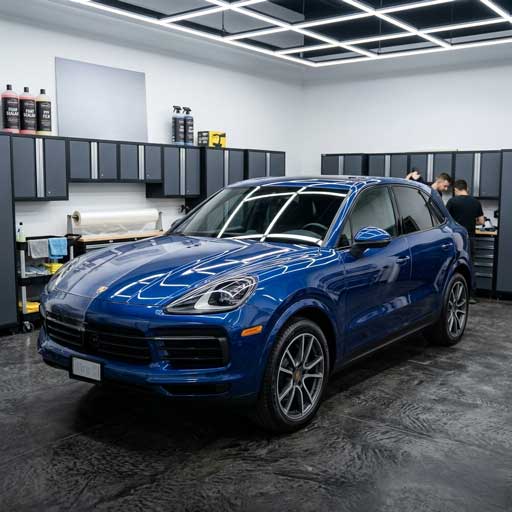
When protecting a vehicle in Calgary, Edmonton, or Red Deer, owners face a critical choice: Paint Protection Film (PPF) or Ceramic Coating? Alberta roads are notoriously hostile. Winter gravel spreads, high-speed debris on the QEII, corrosive calcium chloride, and rapid temperature swings can easily ruin an unprotected clearcoat. Let’s break down the science, differences, and costs of these two technologies.
The Alberta Paint Protection Dilemma
Alberta roads pose unique threats compared to other provinces. High-speed highway runs on Deerfoot Trail or Highway 2 are essentially active sandblasting chambers. Rocks thrown from heavy-duty trucks can puncture paint instantly, leaving exposed steel panels vulnerable to rapid rust.
To defend your vehicle, you need localized defense. However, because both treatments are often marketed simply as “paint protection,” many vehicle owners make the mistake of buying the wrong system. Let’s dissect what each technology actually does.
Paint Protection Film (PPF) Explained
Paint Protection Film Alberta packages—historically known as “Clear Bra”—rely on Aliphatic Polyurethane. This is a physical, 8-to-10 mil elastic film applied directly to the body panels. It acts as a heavy-duty, impact-absorbing armor.
Modern films like XPEL Ultimate Plus or Posh PPF have elastomeric polymers in their topcoat. These self-heal: when hit by flying gravel or scratched during washing, the film’s molecules return to their original state with simple exposure to heat (sunlight, engine heat, or warm water).
For Alberta drivers, Clear Bra Calgary and PPF Edmonton installations are the only effective shield against actual physical stone chips. Ceramic coatings cannot absorb this physical impact.
Nano-Ceramic Coating Explained
Unlike physical film, a Ceramic Coating Calgary or Ceramic Coating Edmonton treatment is a liquid silica glass shell (Silicon Dioxide or SiO2) that chemically bonds to your factory clearcoat at a molecular level.
Once cured, it creates a microscopic, quartz-hard protective barrier. It behaves as an extreme hydrophobic shield, causing water, mud, and Alberta road salt to bead and slide off instantly. It provides an intense, mirror-like gloss and prevents environmental oxidation.
However, because it is only a few microns thick, ceramic coatings cannot absorb rock chips from flying highway stones on the QEII.
Head-to-Head Comparison Grid
To help clarify the differences, here is a breakdown of how both technologies perform under real Alberta driving conditions:
| PROTECTION METRIC | PAINT PROTECTION FILM (PPF) | NANO-CERAMIC COATING |
|---|---|---|
| Rock Chip Defense | Absolute Block: Polyurethane absorbs and dissipates gravel impacts. | Minimal: Too thin to prevent physical stone chip damage. |
| Scratch & Swirl Correction | Self-Healing: Micro-scratches disappear with thermal exposure. | Resistance Only: Hard shell resists scratches, but cannot self-heal. |
| Hydrophobic & Washability | Good: Modern films repel dirt, but can stain over time. | Extreme: Extreme water beading makes washing effortless. |
| Visual Depth & Gloss | OEM Gloss / Stealth: Preserves factory finish or makes it matte. | Mirror-Like: Creates an incredibly deep, wet reflection. |
| Typical Lifespan | 7 to 10 Years: Long term physical protection. | 2 to 5 Years: Requires maintenance top-ups. |
The Ultimate Alberta Combo Shield
Given the performance profile of each system, the best solution for Alberta daily drivers is often a combination of both.
We call this the Combo Shield. By applying high-impact Paint Protection Film (XPEL or Posh) to the front impact zones (bumper, full hood, fenders, headlights, side mirrors) and capping the entire vehicle with a multi-layer 9H Ceramic Coating (including over the film), you achieve the best of both worlds:
- 100% Rock Chip Defense: Your front-end is fully armored against flying gravel kicked up on the Deerfoot or Highway 2.
- Effortless Washability & Shine: The non-impact panels and protected zones repel dirt, tar, and calcium chloride road salt instantly.
- Maximum Value Preservation: Your vehicle retains pristine factory paint with zero stone-chip scarring, ensuring a significantly higher trade-in value down the road.
Making the Right Choice
If your budget allows for only one treatment, consider your driving habits:
Choose PPF if: You drive on Alberta highways (QEII, Highway 2, Anthony Henday) daily, commute through construction zones, or own a brand new vehicle. Physical protection from gravel is your top priority.
Choose Ceramic Coating if: Your vehicle is primarily driven in the city, parked in a garage, and you want an easy-to-clean vehicle with a constant, deep showroom gloss.
At Zima Auto, we specialize in both. We carry out precision installations inside specialized, climate-controlled cleanrooms to protect your vehicle from contamination and guarantee a lifetime of protection.